Home Technology

Technology

Technology

How the photonic building blocks come together for precise, reliable navigation.

Silicon photonics

Silicon photonics makes it possible to guide, modulate and detect optical signals within photonic circuits on a chip, using processes compatible with microelectronics technologies. Where a traditional circuit uses electrical signals, the photonic platform guides optical signals through waveguides and micrometre-scale structures. This makes it possible to measure quantities such as rotation and acceleration and to generate high-stability time references, with high precision and low noise, in a small footprint.

The four technology building blocks

B1

Silicon photonics platform

The core components of the whole system: low-loss waveguides, modulators, photodiodes and resonators, built with standard processes available at commercial foundries.

B2

Photonic inertial unit (IMU)

È dedicata alla misura di accelerazione e velocità angolare. Comprende accelerometri optomeccanici e giroscopi ottici interferometrici. Gli accelerometri optomeccanici convertono in misura ottica lo spostamento di una microstruttura meccanica, mentre i giroscopi ottici interferometrici misurano la velocità angolare mediante interferometria.

B3

Time reference

Un orologio atomico in tecnologia fotonica fornisce il riferimento temporale ad alta stabilità e contribuisce alla sincronizzazione temporale dell’architettura di sistema.

B4

Mini-GNSS/INS system

The control electronics, the integration of the subsystems and real-time data processing on an FPGA, together with system-level integration of the GNSS receiver when the GNSS signal is available.

The four blocks are designed to form a single system architecture. Integration with the GNSS signal happens at system level, not as a function realised entirely on-chip.

How they come together

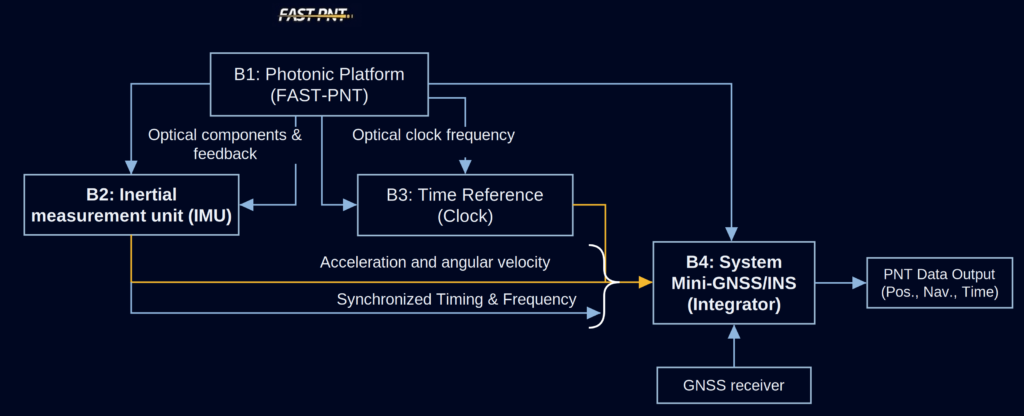
Diagramma a blocchi FAST-PNT

Descrizione del diagramma: la piattaforma fotonica (B1) fornisce i componenti di base all’unità inerziale (B2) e al riferimento temporale (B3); i loro segnali confluiscono nel sistema mini-GNSS/INS (B4), che integra il ricevitore satellitare quando il segnale è disponibile e prosegue con i soli sensori di bordo quando non lo è.

Continuity of navigation

When the GNSS signal is degraded, jammed or temporarily unavailable, on-board inertial measurements and the time reference feed the navigation algorithms and help maintain the solution during the outage. The goal is to contribute to continuity of navigation even when the GNSS signal is absent, degraded, jammed or temporarily unavailable.

Fabless approach

FAST-PNT adopts a fabless approach: the chips are designed in-house and their fabrication is entrusted to specialised external foundries, using standard processes compatible with microelectronics technologies and available at commercial foundries. It is an established model in the microchip industry and aims to make the technology reproducible and scalable towards the market.

Glossary

PNT (Positioning, Navigation, Timing)

determining position, navigation and timing with high precision.

GNSS

satellite navigation systems, such as GPS, used to estimate position and time and to support navigation.

GNSS/INS

a navigation architecture that combines GNSS information with on-board inertial measurements.

INS (inertial navigation system)

a system that estimates position, velocity and attitude from on-board inertial measurements; without external updates, the error can grow over time.

IMU (inertial measurement unit)

a unit that measures acceleration and angular velocity.

Silicon photonics

a technology that builds photonic circuits on silicon-compatible platforms to guide, process and detect optical signals on a chip

Fabless

a model in which chips are designed in-house and manufactured by external foundries.

Optical gyroscope

a sensor that measures angular velocity optically.

Atomic clock in photonic technology

a high-stability time reference based on photonic components and architectures.

FPGA (field-programmable gate array)

a digital integrated circuit whose logic can be reconfigured for real-time data processing.

SWaP-C

small size, weight, power and cost.

GNSS-denied

conditions in which the GNSS signal is absent, degraded, jammed or unreliable.